


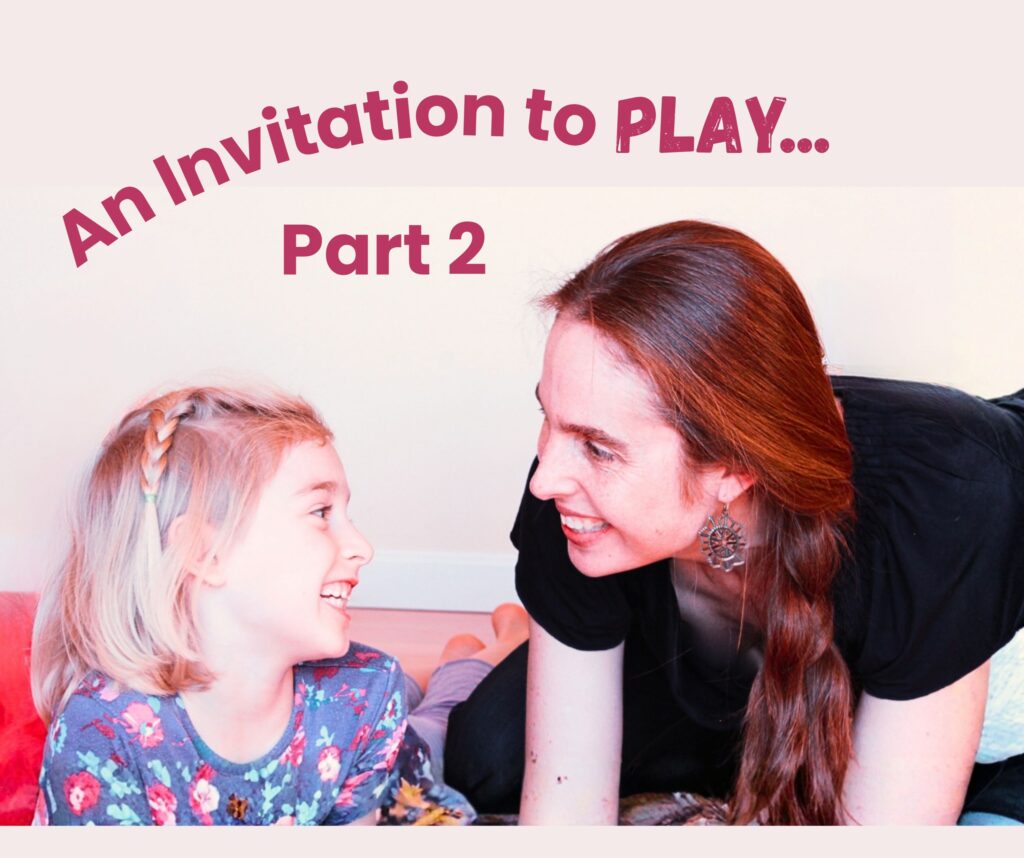
Why Play Matters So Much for Your Child on the Autism Spectrum
Many of our children spend a significant amount of time in Stress Mode – the fight, flight, or freeze mode. Play helps shift this and supports nervous system regulation, so our children can enjoy life, learn, and grow.
Play strengthens connection.
It encourages communication.
It develops flexibility.
It builds confidence.
Learning becomes more accessible.
What If Play Is the Real Work?
Play is not a break from working on developmental skills. Play is one of the primary ways children develop skills, especially when the play involves what your child already loves.
More than twenty years ago, I learned one lesson that has stayed with me ever since: Enter your child’s world before inviting them into yours. When we follow our children’s intrinsic interests and motivations during play, learning comes fast and furious.
If they love trains, play trains.
If they love dinosaurs, play dinosaurs.
If they love lining things up, join them in those activities.
If they love maps, numbers, vehicles, or elevators, become curious about what fascinates them.
When we follow our child’s lead instead of immediately redirecting them toward our own agenda, connection grows naturally.
The choice of activity itself matters very little (as long as it’s something your child enjoys). The activity is simply an avenue for connection and engagement.
Connection and fun then become the bridge to learning.
Many of the greatest developmental gains we can witness in children happen when we are so present in the moment that their world becomes our world. Their interest becomes our biggest passion. In those moments, we become a clear vessel facilitating profound transformation and learning.
I think of a boy who spent our sessions lining up cars along the windowsill. Nose to bumper, silent, no eye contact, unreachable—or so it seemed. Instead of redirecting him to “work,” I sat on the floor and lined up cars beside him. I said nothing for a while. I had fun and imagined my cars were having fun too. Then this little boy started noticing my cars and what I was doing. I made one car “beep” softly. He smiled. The next car drove vertically up the wall until it got “stuck.” He looked at me in anticipation, waiting to see what would happen next.. From that point on, our relationship developed, his desire to participate in what I was doing grew, and eventually we worked on helping him use more language.
As I followed his lead, he eventually became more flexible. Our common interest in this moment—cars—built trust and fed into his desire to engage socially. Eventually, while still having lots of fun, he was willing to learn from me.
The beautiful thing is that, as a parent, you don’t need years of experience to do this. You’re already uniquely qualified because you know your child better than anyone else.
You probably have that favorite cartoon also memorized. You know the exact favorite page in their book. You know the precise order of the cars when they line up. You know what makes your child smile and laugh. Start simple and build from there.
Can you add one simple element to what they already love? Perhaps building a road for their favorite excavator. Or a pearl necklace to go with their mermaid costume. How about printing out a paper mask so you can become Wednesday Addams, Spider-Man, or whoever their favorite character is?
You might ask: When playing, how do we know our children are ready to learn? They are ready to when they become interested in you or what you are doing – when they smile, or laugh at what you offer during playing. At this point, learning not only becomes more accessible, it becomes easier—and it sticks.
That’s the real “work” of play. Play allows us to relax, enjoy life, and ultimately learn more.
